
Polyglot · Web · iPhone Probe
Six languages,
one story.
Learn languages the way they actually relate. The same short story in Russian, Polish, German, Spanish, French and Italian, sentence by sentence, with the shared roots and sound-shift rules drawn between them. Listen hands-free, read side by side, talk back, recall on a schedule.
Noted. One email when Polyglot ships, nothing else.
Our own prototype runs daily · public version only if enough people want it
What it does
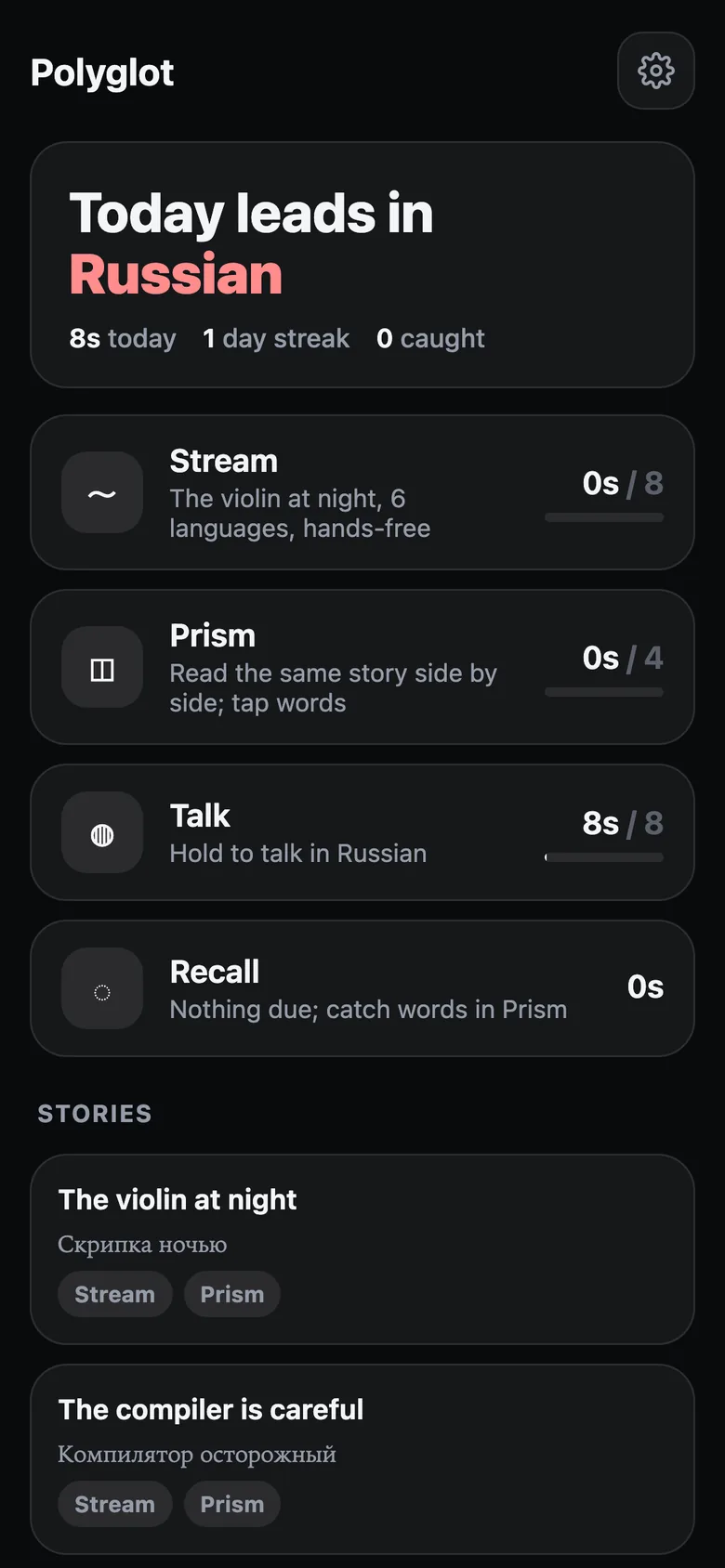
Four ways through the same text.
Stream
Hands-free audio. Each sentence plays through every language in turn, then the day’s lead language again. Walk, cook, drive.
Prism
The aligned text. Words from the same family are underlined in the family’s color; tap one for the card: every form, the root, the outsiders, the rule.
Talk
Push to talk. It answers in the lead language and recasts what you said instead of correcting it. Switch language mid-conversation.
Recall
Words you caught come back at 1, 3, 7, 16, 35 and 90 days: meaning in, say it in your languages out.
A lead language per day
Monday and Thursday Russian, Tuesday and Friday German, and so on. Everything else rides along.
Real rules, not flashcards
Sound shifts and shared roots are the organizing idea, so a word learned in Spanish is half-learned in Italian and a quarter in French.
When
If enough people want it.
The prototype runs daily for one of us. A public version needs accounts, a server and content review. The list is the vote.
Requirements. A browser, and later an iPhone. Audio and Talk use a speech model, so a public version would be a subscription.
One email, at launch
Tell me when Polyglot ships.
No newsletter, no reminders. The address goes nowhere else.
Noted. One email when Polyglot ships, nothing else.
Questions
Questions
Which languages?
Today: Russian, Polish, German, Spanish, French and Italian, plus a constellation line of single phrases in Finnish, Swedish, Chinese, Persian and Arabic. The method works for any set with shared roots.
Is it for beginners?
It is for exposure: all at once, by immersion, with the relations made visible. Beginners ride the wave; intermediates see the structure they half-knew.
Why a probe?
Because a language app that nobody else wants should stay a private prototype. The list is the vote.
More from DutchData